Blog

  • MobileViews 594: Color e-ink tablets deep dive with Frank McPherson & Sven Johannsen


    I sat down for MobileViews Podcast 594 with my longtime friends Sven Johannsen and Frank McPherson. Our usual co-host, Jon Westfall, was away, but we had plenty to cover, ranging from the bite-sized future of entertainment to a massive deep dive into the world of color E-ink tablets.

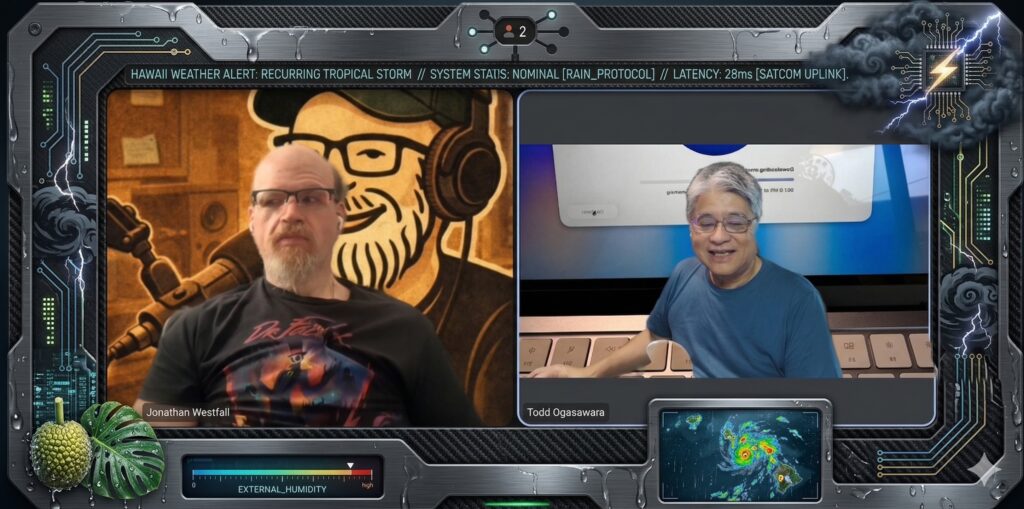
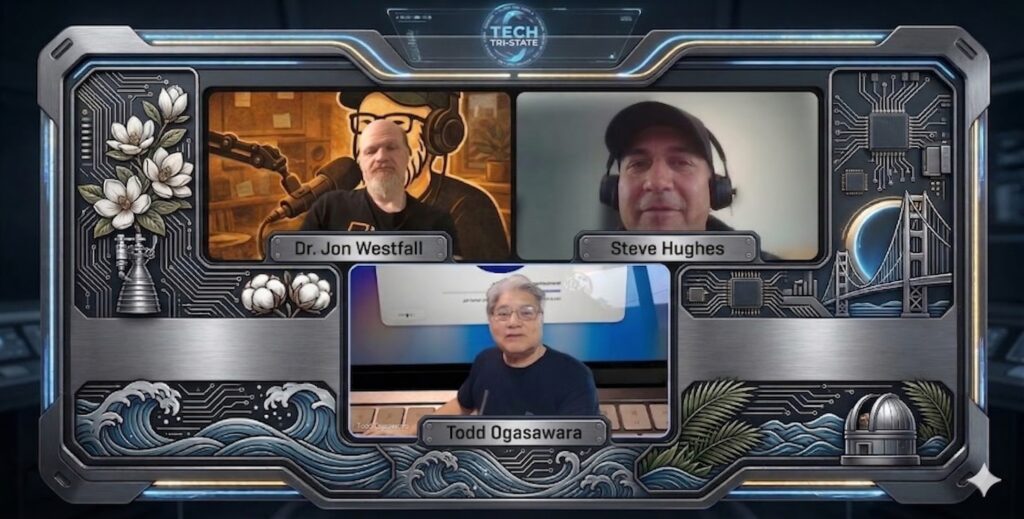
    Note: I prompted Google Nano Banana Pro to convert a screenshot of our Google Meet video call and approximate what the photos of us would look like on a color e-ink tablet.

    We kicked things off by discussing a fascinating trend in East Asia: micro dramas. Specifically, a TikTok subsidiary called Pine Drama is producing miniseries with episodes lasting only 30 to 90 seconds. These “video comic strips” are designed to be highly addictive, and while I have a short attention span, I’m curious to see if this ultra-short format translates well to global audiences.

    On a more serious note, we touched on a security vulnerability called Whisper Pair. This bug affects several major Bluetooth headset brands—including Sony, Google, JBL, and Jabra—allowing for potential location tracking if an attacker is within 14 meters. If you use earbuds from these brands, I recommend checking the specific lists online to see if your hardware is vulnerable.

    I’ve been testing Google Gemini’s personal intelligence features lately, which are surprisingly good at “buttering you up” by knowing your interests in Star Trek or Star Wars. This led to a broader discussion about the AI Divide. With subscriptions like Gemini Pro or Copilot Pro costing around $20 a month, we are quickly moving toward a society of “haves and have-nots” regarding high-level tech tools. We also noted how this digital divide manifests in the real world.

    The heart of our conversation was a deep dive into color E-ink tablets, led by Frank, who has become a true connoisseur of the medium. We compared several major players in the market:

    Frank emphasized that for him, writing is about memory and engagement during meetings. While an iPad has more utility, E-ink offers reflective technology that is easier on the eyes and provides a battery life that lasts for days rather than hours.

    After hearing Frank’s breakdown, I’m strongly leaning toward the Boox Note Air 5C. It’s available on Amazon for about $530 and includes a stylus that uses Wacom EMR technology, meaning I won’t even need to charge the pen.

    Available via Apple iTunes.
    MobileViews YouTube Podcasts channel
    MobileViews Podcast on Audible.com
  • MobileViews 593: CES 2026 wrap-up with guest panelist Frank McPherson


    Jon Westfall and I were joined by frequent podcast panelist Frank McPherson to dive into the highlights of CES 2026. While Jon and I were initially skeptical about whether there would be much to talk about this year, we actually found several soon-to-be-available gadgets that caught our eye, alongside some “worst of” picks like a single-use digital lollipop.

    AI and My Smart Home Transition

    I’ve been testing the new Alexa.com browser-based entry point, which offers a level of vertical integration that really impressed me. Recently, I had to replace a WeMo switch that Belkin is bricking at the end of the month—a trend of “cloud-killing” devices that we’ve also seen with Google and Nest. I bought an Amazon Smart Switch, and when I asked Alexa how to recreate my sunset triggers, the AI offered to do it for me instantly. It’s the kind of seamless experience I’ve wanted for decades.

    LEGO “Smart Play” Bricks

    As an adult fan of LEGO who still remembers the Samsonite-branded sets, I was fascinated by the announcement of Smart Bricks. These bricks include accelerometers, sound synthesizers, and light sensors, with the first kits arriving in Star Wars themes this March. We had a great debate about whether these features—like pre-set battle sounds—help or hinder a child’s imagination. While Frank was concerned about technology “filling in the blanks,” Jon noted that LEGO needs this level of immersion to compete with brands like Funwhole.

    The Evolution of E-Ink and Tablets

    Frank, our resident expert on minimalist digital tech, brought our attention to the TCL “NextPaper” tablet. It uses 120Hz LCD technology but features specialized modes to mimic the reflective look of e-ink. It’s aimed squarely at the Kindle Scribe Colorsoft and Remarkable Pro. Frank made a great point about why these devices matter: for many users, the physical act of writing on a screen is essential for memory retention during meetings.

    Foldables and Mobile Accessories

    We spent some time discussing the “aspirational” Samsung Trifold, which unfolds into an 8-inch tablet but is quite bulky in the pocket. I’m personally watching the iPhone Air, as its thinness suggests it could be half of an eventual Apple foldable. On the accessory front, Clicks made a splash with two items:

    • Clicks Power Keyboard: A MagSafe-attachable sliding keyboard with a 2150 mAh battery. Jon actually pre-ordered this for his iPhone 16 Pro.
    • Clicks Communicator: A standalone BlackBerry-style Android device featuring a physical keyboard, SD card slot, and a 3.5mm headphone jack.

    Wearables and “Tricorders”

    Frequent guest panelist Stephen Hughes was not able to join us for this podcast.  However, he contributed several new products introduced at CES for this podcast discussion.

    • Pebble Round 2: It’s great to see the Pebble brand return with an e-ink watch boasting a two-week battery life and Claude AI integration.
    • Roborock Saros: A $1,000 vacuum that can actually climb stairs.
    • Rocket Smart Glasses: These were a standout because they include built-in diopter adjustments, meaning you can dial in your prescription without needing lens inserts.
    • Kode Dot: A “tricorder for geeks” that looks like a GameBoy controller and acts as a hacker tool.


    Available via Apple iTunes.
    MobileViews YouTube Podcasts channel
    MobileViews Podcast on Audible.com
  • MobileViews 592: Hello 2026. Build vs. buy?


    In this podcast Jon Westfall and I discuss our recent experiences with artificial intelligence and consumer technology (as usual these days). We share insights on using Google NotebookLM and ChatGPT to automate content creation, noting that while the tools are becoming more intuitive, interoperability between different ecosystems remains a challenge. We also discuss the “build vs. buy” dilemma in home automation, highlighting how AI-assisted coding makes DIY hardware projects more accessible than ever. We briefly preview the upcoming CES conference, expressing a mix of hope and skepticism regarding whether the event will debut a truly revolutionary product category.


    Available via Apple iTunes.
    MobileViews YouTube Podcasts channel
    MobileViews Podcast on Audible.com
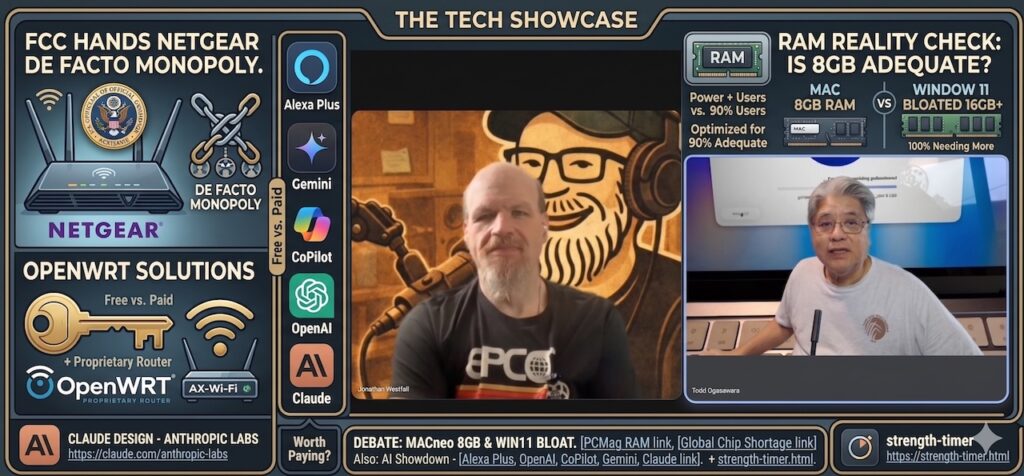
  • MobileViews mini-podcast 51: NotebookLM generated slidedeck summary of 2025 podcasts with voiceover

    MobileViews Mini-podcast 51 is 15 slide deck with voice over summarizing MobileViews podcasts 563 through 591 – roughly the last seven months of 2025. The slide deck was generated by Google NotebookLM using PDF transcripts of the last 29 podcasts.

    How this was produced

    1. Recorded using Google Meet
    2. Transcribed using Adobe Podcast. Export PDF files
    3. PDF files uploaded to Google NotebookLM
    4. Used the beta-release NotebookLM Slide Deck feature to summarize the 29 podcasts. The prompt was: Summarize this set of over half-a-year of podcast transcripts focusing on (1) new hardware, software, and services and (2) categories of discussion about technology not specific to a particular product.
    5. Exported the slidedeck to a PDF
    6. Google Gemini provided possible solutions for creating a video with voice over. However, some of the solutions were dead-ends
    7. However, it did suggest using Adobe’s free web-based PDF to PowerPoint converter. https://acrobat.adobe.com/link/acrobat/pdf-to-ppt
    8. Then, I opened the PPT file using PowerPoint running in Windows 11
    9. NOTE: I had originally hoped to use a Chromebook to create this mini-podcast using Google Vids. But, it seemed easier to use Microsoft PowerPoint.

    Available via Apple iTunes.
    MobileViews YouTube Podcasts channel
    MobileViews Podcast on Audible.com
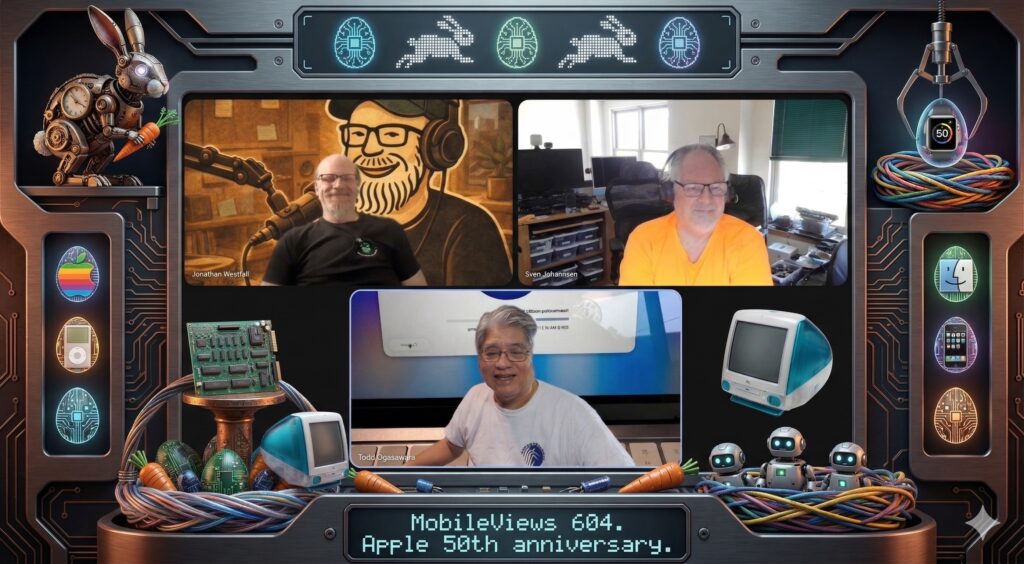
  • MobileViews Podcast 591: 2025 Retrospective; Broadcasting shifts & the digital divide


    In this final “human” podcast of 2025, Jon and I discuss the changing landscape of media distribution, internet connectivity, and the year’s dominance of Artificial Intelligence.

    Episode Highlights:

    • The Oscars Move to Streaming: The Academy Awards has signed a deal to move video distribution exclusively to YouTube starting in 2029. Todd notes that many viewers already consume the content via clips on the platform rather than the full terrestrial broadcast.
    • The Digital Divide: A look at the 4-6% of US households completely without internet access and the 15-20% lacking fixed broadband. The hosts discuss the lingering presence of DSL compared to cable and fiber.
    • Evolving Home Design: Jon highlights a design trend where living rooms are no longer centered around the television, reflecting a shift toward personal consumption on mobile devices rather than communal viewing.
    • 2025 Tech Retrospective: The hosts reflect on how AI dominated the conversation throughout the year.
      • Jon’s Experiment: Using ChatGPT with memory to create a “cognitive time capsule,” documenting his current psychological state and preferences to review in ten years.
      • Todd’s Experiment: Using Google NotebookLM to analyze and summarize PDF transcripts of the podcast’s history.
    • iPadOS 26: Todd notes that despite improved windowing features in iPadOS 26, his personal workflow has remained largely unchanged.

    Next Week: Todd plans to release an automated summary created via AI tools to close out the year.

    Available via Apple iTunes.
    MobileViews YouTube Podcasts channel
    MobileViews Podcast on Audible.com
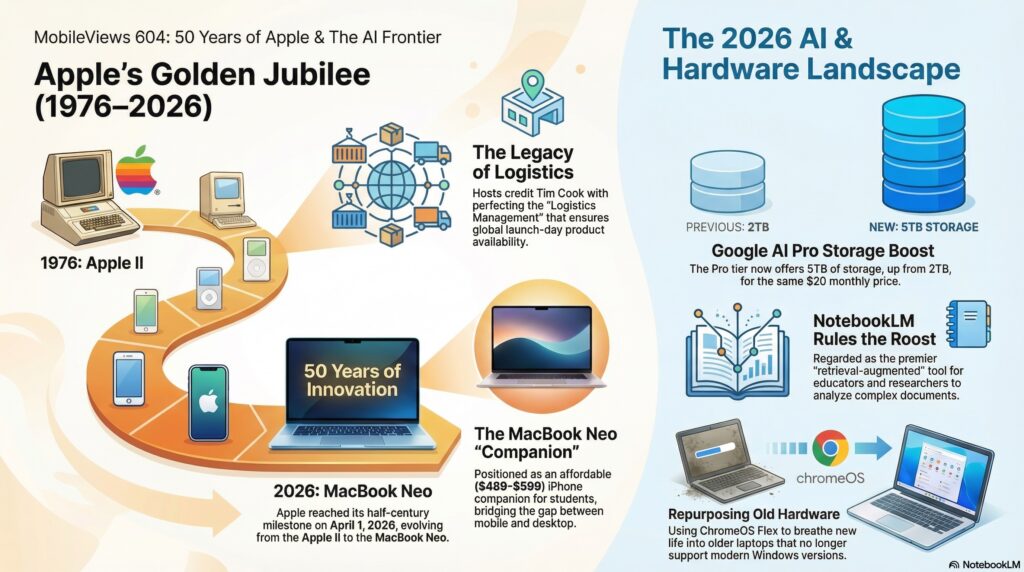
  • MobileViews Podcast 590: Simplifying Tech Stacks, AI News, and Apple Updates


    In this episode, Todd and Jon discuss the latest AI agreements, updates to the Apple ecosystem (OS 26.2), and the history of PowerShell. The core discussion focuses on the “overcomplication issue” facing tech enthusiasts and offers hardware and software tips to simplify daily workflows.

    AI & Industry News

    • Disney & OpenAI: The Walt Disney Company has reached an agreement to license characters to OpenAI’s Sora.
    • Google Labs: Todd joined the waitlist for “Google Disco,” a tool that uses “GenTabs” to create interactive web apps and complete tasks using natural language without coding.
    • Visual Podcasting: Todd discussed using “Nano Banana Pro” and Gemini to create visual whiteboard summaries for podcast notes.

    Apple OS 26.2 Updates

    • watchOS 26.2: Features updates to Sleep Scores, which Jon notes can feel “judgmental” regarding sleep quality.
    • iPadOS 26.2: Reintroduces multitasking features like slide over and enables “Auto Chapters” for podcasts.
    • macOS 26.2: Introduces “Edge Light” (a virtual ring light for video calls) and “low latency clusters” for local AI development on M5 Macs.

    Tech History

    • PowerShell Origins: Jeffrey Snover, creator of PowerShell, revealed in a blog post that “cmdlets” were originally named “Function Units” (FUs), reflecting the “Unix smart-ass culture” of the era.

    Discussion: Simplifying the Tech Stack

    The hosts discuss the tendency to overcomplicate setups, such as using Docker for RSS feeds or complex SSO for home use. They recommend the following simplifications:

    Hardware

    • KableCARD: A credit-card-sized kit containing multiple adapters, a light, and a phone stand to replace carrying multiple cables.
    • Presentation Remotes: Use a simple dedicated remote ($20–$30) or repurpose a Surface Pen via Bluetooth instead of relying on complex software solutions.

    Software

    • Pythonista (iOS/macOS): Run simple local scripts (e.g., GPA calculators) rather than paying for dedicated subscription apps.
    • Homebridge: A lighter-weight alternative to Home Assistant for connecting IoT devices (like Sonos) to Apple HomeKit.

    Troubleshooting Tip

    • Pixel Tablet YouTube Glitch: If the YouTube app on the Pixel Tablet displays unusable, giant thumbnails, the fix is to clear both the app’s cache and storage/memory.

    Available via Apple iTunes.
    MobileViews YouTube Podcasts channel
    MobileViews Podcast on Audible.com